
Compare the Three Main Benton County Property Values
Name the number first. That discipline anchors any Benton County property value comparison. Indiana assessors use market value in use for assessment, while a recorded transaction offers direct evidence of what a parcel sold for. The tax bill then applies deductions, rates, credits, and caps to a net assessed value, so it is a liability calculation rather than an opinion of market worth.
| Value type | Meaning in this search | Official record route |
|---|---|---|
| Assessed value | Tax-base value set under Indiana assessment rules for a stated year | Benton Assessor, Benton GIS or DLGF assessed-value search |
| Market value in use | Indiana's assessment standard for the property's use, not a sale guarantee | Assessor assessment record and Form 11 notice |
| Last sale price | Consideration tied to a particular transfer and date | Public sales disclosure route and recorded deed evidence |
Benton County publishes no local assessment-ratio table. Skip generic percentages too. Compare only figures whose year and definition are known. Treat gross and net assessed values as separate fields whenever deductions are involved. A ratio borrowed from another county would distort the math.
Keep the source label beside each amount. "Assessed value" should point to the Assessor or DLGF record and its year. "Sale price" should point to the disclosure or recorded transfer and its date. Reserve "opinion of market value" for an appraisal or other valuation work. Never apply it to a number silently inferred from a tax or deed screen.
Find a Benton County Assessed Value Through Official Routes
The Benton County Assessor keeps parcel characteristics and assessed values. Online routes include Benton GIS, Beacon, and the DLGF assessed-value search. Beacon's card fields vary by portal. The statewide DLGF search offers a Details view, partial-search guidance, and an Excel download for every county. County data remain the final word. Confirming a figure against the local record keeps a state row from standing in for the assessor's own numbers.
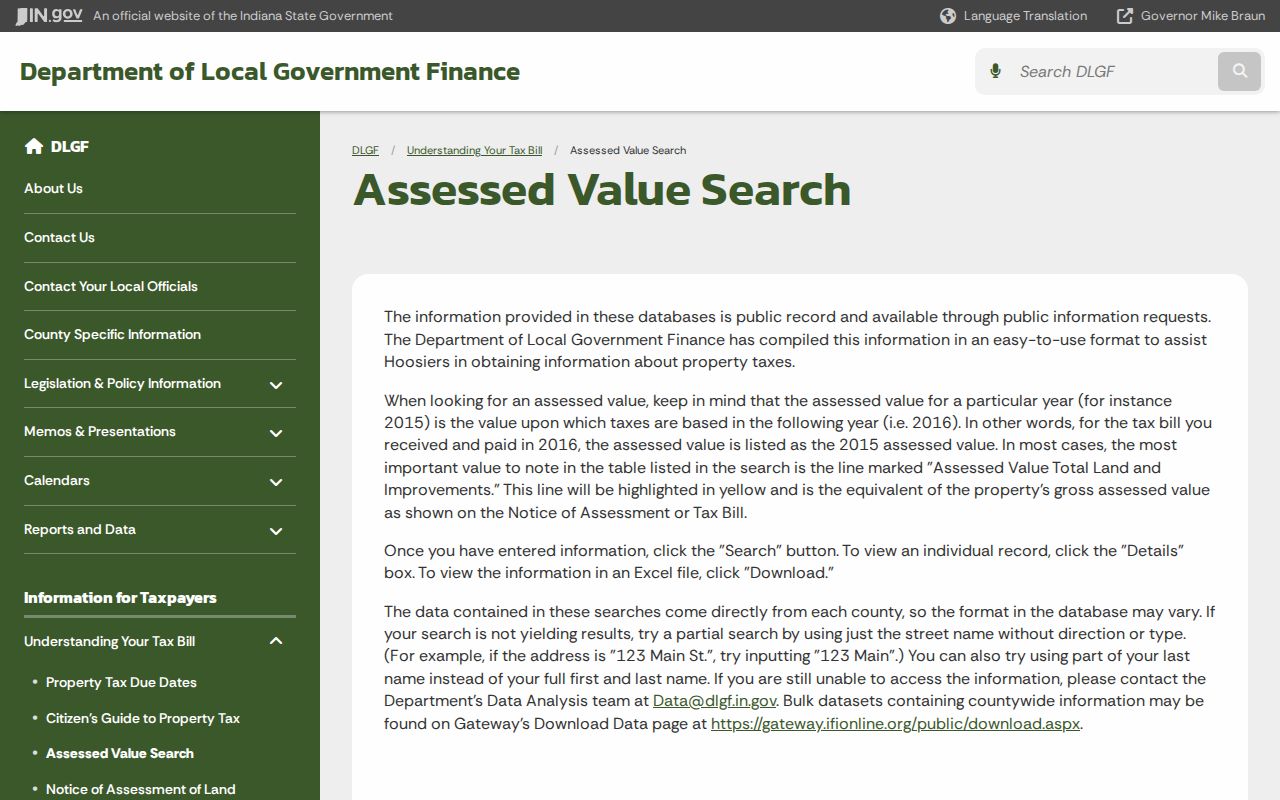
Search by address first. Try a partial street entry too. Then confirm the county and parcel number before reading the value, since similar road names and rural delivery labels can return a plausible but wrong match. Downloaded rows need the same parcel check. A spreadsheet proves only what the system returned, not independent confirmation of identity or current accuracy.
Look Up a Benton County Property Value with Its Date
A value without its year misleads. Search by the exact address first, switching to the parcel number when the address proves weak, and keep the assessment year beside the amount. The sale-disclosure route fits only when transaction evidence matters.
- Search Benton GIS, Beacon, or DLGF by address and confirm the correct parcel number.
- Record the assessment year, gross assessed value, and any separate land or improvement figures shown.
- Keep net assessed value separate because deductions can change the tax base without changing the underlying assessment.
- Check a public sales disclosure or recorded transfer for the sale amount and its own transaction date.
- Assessed value
- The valuation used as the starting tax base for a stated assessment year.
- Market value in use
- Indiana's valuation standard based on the property's utility to the owner or similar user.
- Sale or consideration price
- The amount tied to a specific transfer, subject to the context of that transaction.
- Reassessment
- A scheduled review of assessed values, supplemented by annual adjustment work.
Separate Benton County Sale Price from Assessed Value
Indiana's public sales-disclosure search covers disclosures filed after July 1, 2008. A disclosure or deed-related record can show real transaction evidence. A sale can still carry unusual terms. Unusual interests can make a simple price comparison poor. Match the parcel before treating the amount as the subject property's last sale. Match the legal description too.
The Recorder's recorded instrument and the disclosure answer different questions. The assessment is a tax valuation for its year. The sale amount belongs to a transaction date, and the recording date may fall later. Keep all three dates on the comparison sheet.
Consideration can also reflect facts the number alone does not show. A deed may transfer several tracts, a partial interest, or land tied to another agreement. The public disclosure route is a strong transaction lead. But the parcel and legal description must match first. Then it serves as a Benton County property value comparison. Read the instrument when context matters.
Read Benton County Property Values Through Annual Trending
DLGF's 2025 annual-adjustment fact sheet says 2025 assessments rest on 2024 sales. Assessors compare those sales with assessments to build adjustment factors. That lag explains the gap. A current assessed value may not equal the latest sale or today's expected market outcome.
Annual adjustment and cyclical reassessment differ. Indiana materials describe a four-year reassessment cycle with annual trending work between cycles. The record's effective year and notice date beat assumptions. Not every displayed amount was created the day the portal was opened.
Place each year's assessment on its own row. Note any land, improvement, or classification change the record shows. A jump may coincide with trending, new construction, a parcel split, or a corrected characteristic. The amount alone cannot name the cause. Ask the Assessor for the relevant property record or notice. Do not supply a story the source does not support.
Interpret Benton County Rural Property Value Context Carefully
Benton County describes itself as more than 90 percent agricultural. Its Fowler community materials count 653 wind turbines and 1,288 megawatts across the landscape. Numbers that big invite questions. How does wind energy, drainage, or land class affect a particular tract? The honest answer is that county-wide statistics cannot tell you. They say nothing about whether one parcel hosts a turbine or carries a wind agreement.
Test parcel-specific claims against the records themselves. The GIS layers show what sits on the land. Recorded instruments show easements, leases, options, and rights-of-way attached to the deed. The assessment record adds land class and any improvements. None of these documents calculates the present worth of a private energy agreement.
Keep the two jobs separate. Record collection comes first. Professional valuation and title work follow. Turning a county energy statistic into a premium, discount, or zoning conclusion about a single Benton County property value is not analysis; it is guesswork dressed up as one.
Ask the Benton County Assessor When the Value Screen Fails
The Benton County Assessor's office sits in Fowler, Indiana. The address is 706 E 5th Street, Suite 23, Fowler, Indiana 47944. Reach the staff by phone at 765-884-1205 or by email at assessor@bentoncounty.in.gov. Have the parcel number, the address, and the assessment year ready. Also have the exact field in question. When an assessment record is not online, a written Indiana APRA request is another way to obtain it.
Two other offices handle related questions. Deductions and net assessed amounts belong with the Auditor, Suite 21, at 765-884-0760. Bills and payments belong with the Treasurer, Suite 22, at 765-884-1070. Each office explains a different figure, and none of them produces a separate market estimate.
Calling or writing? Include the screen date, the assessment year, the parcel number, and the label on the disputed amount. That detail separates two problems. One is a stale portal display. The other is confusion over gross value, net value, or payment-year data. A newly recorded deed can raise the question too. If so, add its instrument or recording date. But do not assume a sale price resets the assessment.
Keep Three Benton County Property Value Dates Apart
Three dates drive three different numbers. A worksheet needs separate columns for assessment year, transaction date, and tax-bill year. The assessment may reflect an earlier sales window. The transfer can happen later still. The bill often becomes payable in yet another year, after deductions and rates are applied.
Keeping those dates straight makes comparisons across nearby parcels far clearer. It also stops the last sale price from being misread as the assessor's current figure. Bill calculations raise their own questions. Exemptions and appeal procedure do too. For those details, turn to the Benton County property tax records guide.
Know What a Benton County Assessed Value Cannot Prove
An assessed value is a mass-appraisal tax figure for a stated period. It proves what the tax roll says, nothing more. It cannot forecast a sale price or vouch for the condition of improvements. It cannot settle a boundary dispute or replace a parcel-specific appraisal. A recorded deed is historical evidence. It is not a guarantee of what the property is worth today.
Value is not price. A Benton County assessed value supports taxation; it is not a promise of sale price and is not an appraisal.