
Trace Benton County Former Owners Across Two Record Eras
Benton County former owners live in two linked eras. The Recorder's modern index is the fastest start for a recent transfer. Older chains need more digging. A State Library film guide carries the trail into nineteenth-century land and deed material. Begin with the newest reliable instrument and move backward. The table separates true conveyance sources from maps or probate records that merely explain a change.
| Ownership source | Documented span | Access point | Best use |
|---|---|---|---|
| Recorder deed and easement index | April 1977 to current | Doxpop account or Recorder counter | Grantor, grantee, instrument, and modern transfer sequence |
| Recorder mortgage index | 1992 to current | Doxpop account or Recorder counter | Financing and later release clues, not ownership by itself |
| Deed books and indexes on film | 1835 to 1901 | Indiana State Library and Recorder | Earlier deeds located through book and page |
| Land and tract records | Land 1832 to 1901; tract book 1832 to 1875 | Indiana State Library film guide | Early land entries and township-section continuity |
A chain that crosses 1977 needs the Recorder. Take the last modern deed's legal description and its prior-instrument clues to the counter. That covers the years before the digital index. Staff can bridge the gap. For the oldest period, consult the Benton County microfilm guide before a library visit. Nothing posted online covers 1901 through March 1977 in a continuous run. That interval calls for a written request rather than an assumed web search.
Benton County's Modern Former-Owner Starting Point
The Benton County Recorder has back-scanned and indexed deeds and easements from April 1977 forward, and mortgage coverage begins in 1992. Images sit on Doxpop and require an account. That 1977 cutoff is an access boundary, not the date land records began. Flag it when a chain moves earlier.
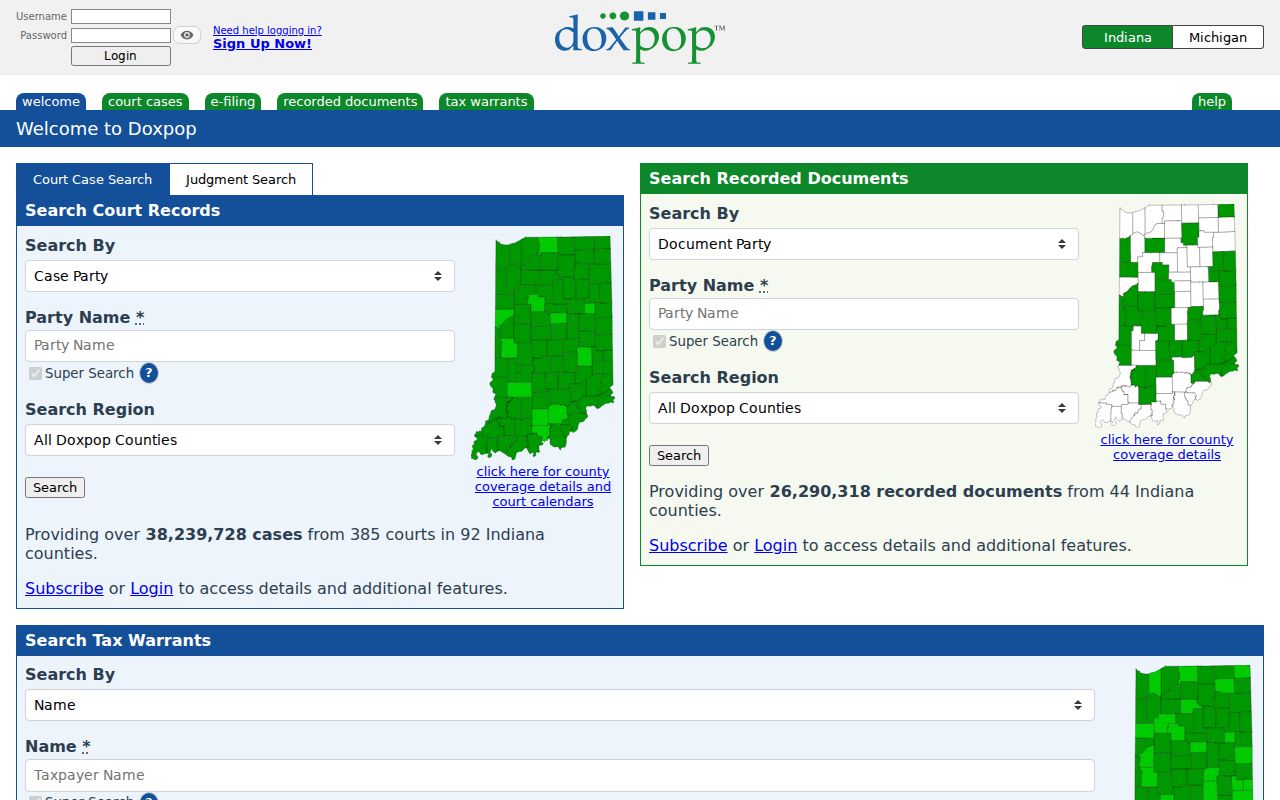
The Doxpop landing page is the online destination. The Recorder supplies the Benton-specific coverage details. No sample grantor-grantee result appears without an interactive account session.
Read Benton County Grantor and Grantee Roles in Reverse
A deed names two parties. The grantor conveys the interest, and the grantee receives it. Tracing former owners flips the roles. The newest grantee on a Benton County deed is the starting person or entity. The grantor on that same instrument is the next candidate back in time. Always carry the legal description forward. Two people with the same name may have held different tracts.
- Grantor
- The person or entity conveying the interest shown by the deed.
- Grantee
- The person or entity receiving the interest shown by the deed.
- Chain of title
- The ordered run of instruments affecting title to the same land.
- Reverse index
- An index arranged to find instruments by the grantor's name.
- Warranty and quitclaim deeds
- Different forms of conveyance whose legal effect must be read from the instrument, not guessed from the index label.
Walk a Benton County Ownership Chain Backward
Treat every transfer as a linked row. Begin with a deed already tied to the subject parcel. The grantor there should appear as grantee on an earlier acquisition, though spelling, initials, trusts, estates, and business names may call for variants. A matching name alone never proves the link. Compare the legal description and prior-reference fields before accepting any match.
| Transfer date | Grantor to grantee | Deed form | Book, page, or instrument |
|---|---|---|---|
| Newest recorded date | Prior holder to current grantee | Read from instrument | Capture exact reference |
| Earlier acquisition | Earlier holder to prior holder | Read from instrument | Match the same legal description |
| Pre-index link | Continue through deed-book parties | Read full deed | Carry book and page to the next search |
- Find the latest purchase deed and verify that its legal description fits the subject land.
- Copy the grantor's full indexed name, recording date, deed form, and instrument or book-page reference.
- Search that grantor as an earlier grantee, testing supported name variants while keeping the land description fixed.
- Repeat until the modern index ends, then take the last reliable reference to deed books, microfilm, or the Recorder counter.
Continue Benton County Former-Owner Research Before Doxpop
Benton County's earliest ownership questions reach back through the Indiana State Library's Benton film guide. Its holdings include land records for 1832 through 1901, deeds for 1835 through 1901, and a tract book covering 1832 through 1875. That is a real bridge to the county's first owners of record. For 1901 through March 1977, the Recorder can tell you which deed-book index, film, or in-office search fits the year you need, since no continuous online run covers that span.
The Recorder sits at 706 E 5th Street, Suite 24, Fowler. Reach the office by phone at 765-884-1630, by fax at 765-884-2013, or by email at gwallpe@bentoncounty.in.gov. A strong request names the parties, the approximate year, the legal description, and any last known book, page, or instrument number. When the material is public but not posted online, Indiana APRA also backs a reasonably particular written request for the deed records you need.
Online cutoff. Benton deed and easement indexing reaches April 1977, so older former owners may require deed books, microfilm, and counter help.
Follow Benton County Estate Transfers That Break a Simple Chain
Some ownership changes never look like an ordinary sale. A death may send a parcel through a probate decree, an executor or personal representative, and only then a recorded deed. The Benton County Clerk keeps the probate material. The Recorder keeps the instrument that finally changes the land record. A death certificate alone settles nothing about title.
The State Library's Benton guide points to a Benton Review wills and estates index for 1920 through 1995, plus marriage and vital indexes that help sort out historic names in the county. Treat these as leads. They do not replace the probate file or the conveyance itself. When an estate name interrupts the deed sequence, ask the Clerk at Suite 37, 706 E 5th Street, or call 765-884-0930 to pull the estate's property records.
Use Benton County Plats and Maps to Hold the Land Still
Names and parcels both drift over time. A tract may be split, replatted, or described with older township, section, lot, and block terms, so former owners can sit under labels that no longer match. Historic maps help align those descriptions. The State Library catalog holds a 1940 land-use map, a 1956 surveyor map, and a 1972 county atlas and directory. It also lists a 1996-97 Benton-Newton plat book with city street maps and an owner index, plus a 2013 plat book.
Use the Benton map and plat catalog first. Confirm access before expecting a scan. Map labels can point the next deed search, but they establish no ownership and replace no survey.
Check Instrument Clues Around Benton County Past Owners
Book and page citations do the heavy lifting. So do instrument numbers, legal descriptions, and any reference pointing back to an earlier deed. Together they form the strongest bridge. They link one generation of Benton County property records to the next. Mortgages, releases, assignments, liens, and easements muddy the water. A name can surface there. The reason may have nothing to do with holding fee title. Treat those documents as a side track. Let the deed sequence stay your main timeline for tracing past owners of record.
Need a copy of one instrument or a closer look at it? The Benton County deed records guide lays out the Recorder route in detail. A former-owner search asks a different question. Does each conveyance tie to the same parcel? Does it link to the next prior grantee in the chain?
Know How Far Benton County Former-Owner Records Reach
Benton County itself dates to 1840. The State Library film inventory, though, starts land material in 1832. Its deed books begin in 1835. That gap is worth noticing. Coverage can predate county organization and reflect parent-county or early land-entry context. No courthouse fire or destroyed decade appears in the official record. So do not lean on that story when a link in the chain goes missing.
When the trail stalls, take the exact missing interval to the Recorder, the Indiana State Library genealogy room, the Benton County Historical Society, or a local library. The Historical Society sits at 404 E 6th Street in Fowler, P.O. Box 341, reachable at 765-884-8839. Its county histories and newspaper files may clear up a name or a place. Still, the deed itself remains the conveyance evidence in Benton County property records.
Lawful use. Research former owners for house history, estate work, and property diligence; never use the record trail to target or harass a living person.