
What Benton County Deeds Record
A deed records a transfer of an interest in land. Or at least it records a claimed one. The label shown in an index matters less than the document itself. What counts is the wording and the signatures. It is also the acknowledgment, the legal description, and the recording reference. The Benton County Recorder also keeps mortgages, assignments, releases, real-estate contracts, powers of attorney, planned developments, plats, surveys, affidavits, mechanic's liens, federal tax liens, and sewer liens. These instruments may burden, release, describe, or explain the land without conveying it at all.
| Deed Type | What It Does | Typical Record Question |
|---|---|---|
| Warranty deed | Conveys an interest with stated title promises | Was land sold with broad covenants? |
| Quitclaim deed | Conveys whatever interest the grantor has, if any | Was a family, estate, or ownership issue adjusted? |
| Trustee or fiduciary deed | Shows a transfer by a person acting in a stated role | Did a trust or estate make the conveyance? |
| Tax deed | Documents a conveyance following the tax-sale process | Did delinquency lead to a later recorded transfer? |
| Sheriff’s deed | Documents a transfer tied to a court-directed sale | Is the conveyance linked to a foreclosure case? |
Treat these descriptions as search aids. They are not conclusions about the legal effect of any specific instrument, so read the full document and its related recordings before drawing one.
Trace Benton County’s Grantor Index
The Recorder links Doxpop as the online route into modern Benton County deed records. The interface does not advertise exact Benton search fields or a sample result row, so expect the layout to differ from any assumed dropdown. The core method remains a grantor-grantee search. Follow the names of the parties giving and receiving an interest. Then compare dates and land descriptions across the results.
- Begin with the present owner lead from the assessor or a known recent deed. Search that name as a grantee, the party receiving the interest.
- Open the likely conveyance and note the grantor, recording date, instrument number or book/page, deed type, and legal description.
- Search that grantor as an earlier grantee. Match the same tract rather than accepting a name match alone.
- Repeat until the desired date or the online coverage boundary is reached. Move to the Recorder’s books or State Library film for older links.
- Grantor
- The party giving or conveying an interest.
- Grantee
- The party receiving the stated interest.
- Chain of title
- The linked sequence of instruments affecting the same land.
- Book/page
- A volume and page citation used to locate a recorded document.
- Instrument number
- A unique recording reference assigned to a document.
Benton Deed Records Have Two Cutoffs
Benton County's Recorder states that the office computer went live July 1, 2002, but the searchable modern span runs wider because older records were scanned back. Deeds and easements reach from April 1977 to the present. Mortgages only reach back to 1992. That gap matters. A deed search reaching into the 1980s can still miss the mortgage history of that same decade.
Doxpop access and images require an account under the county's instructions. Note which collection and date span you actually searched. An empty online mortgage result before 1992 does not prove no mortgage existed, just as a pre-April 1977 deed is not missing simply because it falls outside the modern online run.
Two digital boundaries. Use April 1977 for deeds and easements, but 1992 for mortgages; older records require the Recorder or historic film.
View Benton County’s Deed Portal
The Doxpop access page assigned to Benton County deed records identifies the online service for the search.
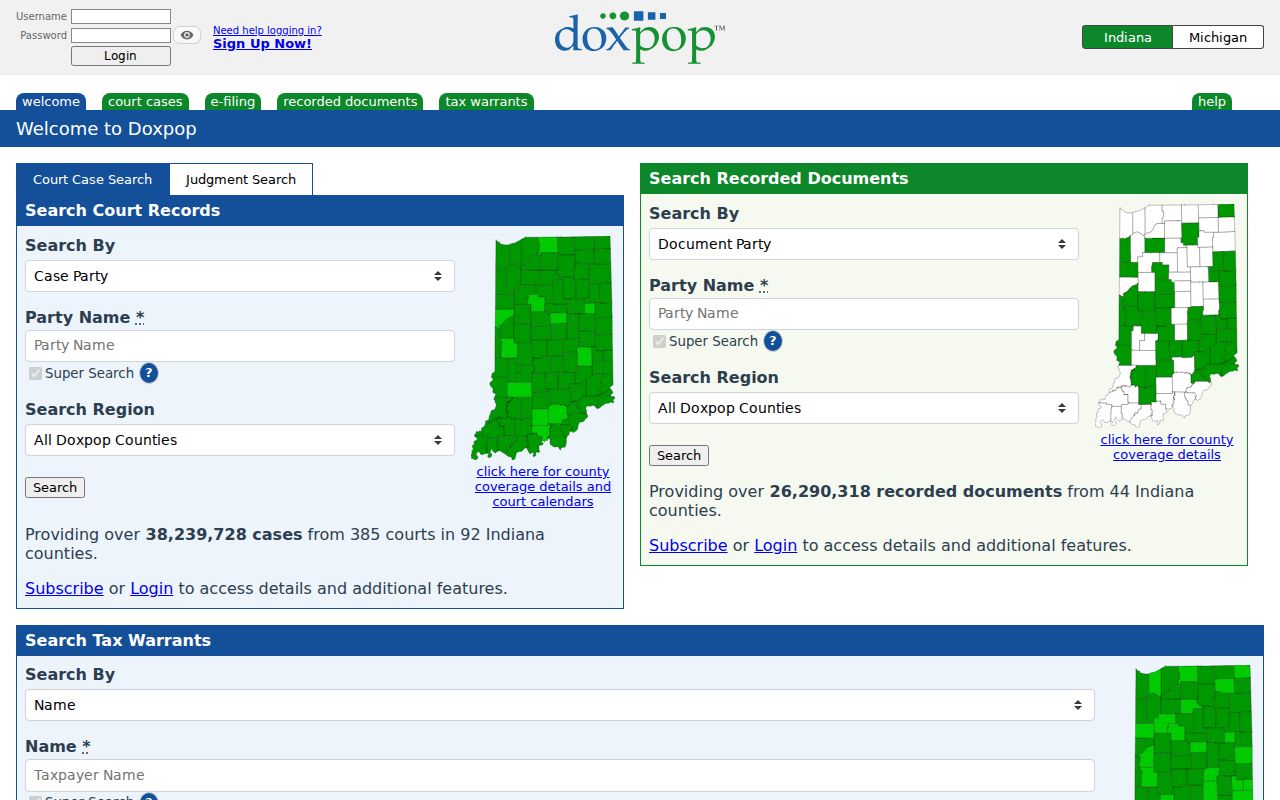
The access page identifies the online service only. Benton County's Recorder page remains the source for local coverage, account requirements, and the counter fallback. When you open a live session, verify the actual party roles and recording references yourself. Never treat an expected field as a confirmed one.
Reach Benton Deeds Before 1977
The Indiana State Library Benton film guide supplies the older bridge. Its holdings list land records from 1832 to 1901. It also holds deed records from 1835 to 1901. A tract book covers 1832 to 1875. Those dates show why the modern Doxpop cutoff is not the beginning of Benton County land records.
At the Recorder counter, ask for the deed index and book. Bring party names, an approximate date, and a legal-description clue. At the State Library, begin with the film guide. Confirm access or copying procedures before promising a scan. The Benton County Historical Society and the Fowler, Oxford, and Otterbein libraries can help resolve old spellings. They can also clarify road names and town references. Still, a local history is only a clue until the deed citation turns up.
The film holdings overlap the modern search only indirectly. Much of the twentieth century rests with the Recorder's physical indexes, deed books, and microfilm. Build the request from both ends. Identify the last reliable modern conveyance. Then bring the older party name and approximate recording period to the counter. A tract-book entry can help follow an early land description. But pair it with the deed index and deed book before assigning a former owner of record to the parcel.
Note: Oxford's first-courthouse history may explain an old place reference. But current deed custody remains with the Recorder in Fowler.
Read Benton Instruments Beside Deeds
A deed rarely tells the whole ownership story. A mortgage can show financing. It does not transfer title the way a conveyance does. An assignment may move a secured interest to a new holder. A release discharges a lien or mortgage. An affidavit may clarify identity or facts but conveys nothing. A plat or survey ties deed language to ground.
Search the same party names and property description for related recordings near the conveyance date. Cross-references repay close study. Benton County's fee sheet adds charges for multiple-transaction documents and extra cross-references. One recorded item can point to several transactions. It can also point to earlier instruments. The index opens the door. It never replaces reading the documents themselves.
Estate transfers may need a parallel Clerk search for the probate file. The later deed makes sense beside that file. A foreclosure-related sheriff's deed can point back to a MyCase docket, judgment, or sale notice. Court and probate records explain the authority. The Recorder supplies the instrument that entered the land-record chain. Sealed, confidential, or older court material must be requested from the Clerk. Never infer it from a missing public docket.
Order Benton County Deed Copies
Ordering official copies runs through the Benton County Recorder. The office sits at 706 E 5th Street, Suite 24, Fowler, IN 47944. The counter is open Monday through Friday, 8:30 a.m. to 4 p.m. Eastern, except major holidays. Reach the office at 765-884-1630, by fax at 765-884-2013, or by email at gwallpe@bentoncounty.in.gov. A precise request speeds things along. Include the names and the deed date. Also include an instrument number or book/page cite, and the parcel or legal description.
The county's fee sheet puts ordinary copies at $1 per page. That rate applies to sheets 11 by 17 inches or smaller. Larger pages run $5 each, and certification adds $5. Online, Doxpop sells document images with an account. Anything missing there can be requested at the counter or through a written Indiana Access to Public Records Act request describing the record with reasonable particularity.
A plain copy suits most research. A certified copy carries the custodian's certification, which some formal filings demand. Certification still does not make the Recorder a title examiner.
A Benton County Deed Scam Warning
The Benton County Recorder warns owners about an Indianapolis mailing styled “LOCAL RECORDS OFFICE”. That solicitation asked $109.50 or more for a deed copy. It is private. It is not a county invoice. Compare any offer with the Recorder's official copy fee and contact the office before sending money.
The contrast is sharp. The county fee sheet lists a standard small-page copy at $1 per page. Certification adds $5 when it is requested. Some users may choose an online service for convenience. A mailed demand is still not an official duty, lien, or deadline. Keep the envelope if the wording looks deceptive, then verify the recording directly.
Prepare Benton County Recorded Documents
Searching and submitting are different tasks. The Recorder lists preparation requirements that include the preparer's name, margins, notary details, matching printed names below signatures, ten-point type, a Social Security number redaction affirmation, a physical grantee address on conveyances, and Auditor endorsement for real-estate transfers. The office cannot prepare a deed. It cannot give legal advice either.
Authorized filers may use Simplifile or CSC for electronic recording. Those vendor routes are submission channels, not a promise of free public search access. The fee sheet lists $25 for deeds, UCCs, and other documents, subject to its size and cross-reference rules. Confirm current requirements before recording. A rejected filing can delay the public chain.
Know Benton Deed Record Limits
A recorded deed proves entry into the public record. It settles less than people assume. It does not by itself resolve priority, capacity, forgery, an unrecorded interest, a faulty description, or probate and court issues. A tax bill, GIS owner label, and deed index can agree and still fall short of a professional title examination.
Recorded is not guaranteed. Benton County deed records show filed instruments, not a legal opinion that title is valid, complete, and free of claims.
The Benton County property search handles the address-to-parcel basics. Deeds only carry the story so far. For a transaction, disputed boundary, estate, or complex chain, take the actual documents to a qualified Indiana title professional or attorney.